
学术精英的发声:医学考研英文自我介绍指南
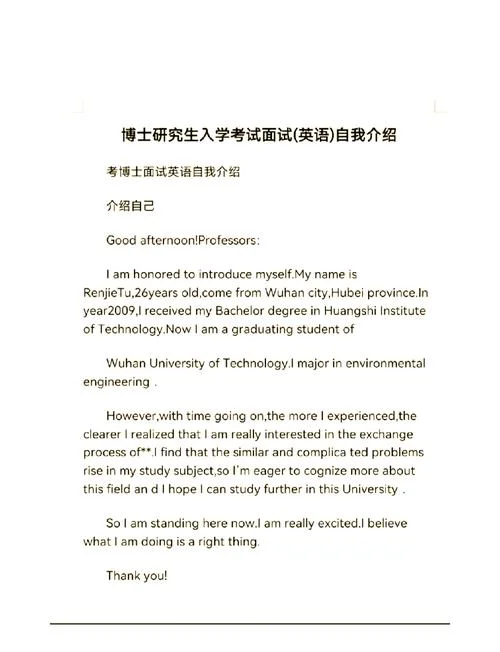
在激烈的医学考研竞争环境中,英语自我介绍不仅是展示语感的窗口,更是构建个人学术形象的基石。对于准备参加研究生入学考试(考研)的医学生而言,一份出色的英文自我介绍能够瞬间抓住评审专家(Admissions Committee)的注意力,传递出严谨、专业且充满热情的学术态度。
以下文章将从核心策略、结构框架、数据支撑及实战范文四个维度,为你全面解析如何撰写一份高质量的医学考研英文自我介绍。
核心策略:从“语言展示”转向“学术匹配”
医学领域的考研不同于纯文学或商科考研,评审专家不仅关注语言能力的流畅度,更看重科研潜力、专业背景匹配度以及临床思维。
1. 明确定位 (Positioning):
不要试图面面俱到。根据专业方向(如内科学、外科、影像科等),将自我介绍聚焦于与目标专业最相关的经历。
原则:用数据说话,用案例佐证。避免泛泛而谈的形容词堆砌。
2. 痛点解决 (Problem Solving):
评审专家在 15-20 秒内完成筛选。自我介绍应直接回应潜在质疑:你的学习能力如何?你的科研潜力如何?你的职业动机是什么?
3. 结构化表达 (Structure):
遵循经典的“总 - 分 - 总”逻辑,保持逻辑的连贯性,体现清晰的思维过程。
结构框架:导师眼中的黄金模板
一份标准的英文自我介绍包含以下四个板块,每个板块都有其特定的功能:
| 板块 | 时长预估 | 核心功能 | 关键内容 |
|---|---|---|---|
| 开场 (Opening) | 15 秒 | 破冰与自信 | 姓名、称呼、问候,直接表明身份及报考意向。 |
| 学术背景 (Academic Background) | 30 秒 | 证明基础 | 本科专业、主修课程、 GPA、荣誉奖项。 |
| 科研与经历 (Research & Experience) | 40 秒 | 核心亮点 | 科研项目、临床实习、竞赛获奖(数据化)。 |
| 动机与规划 (Motivation & Plan) | 30 秒 | 逻辑闭环 | 对医学的热爱、未来职业规划、与导师的契合点。 |
数据支撑:用事实构建说服力
医学界崇尚“实证”。在自我介绍中,数字(Numbers)是无可替代的武器。模糊的陈述(如“我太喜欢这个专业了”)不如具体的事实有力。
学术成绩量化
策略:列出核心课程成绩,并计算加权平均 GPA。 话术示例:"My GPA of 3.8/4.0 in high school indicates a rigorous academic foundation, with a top-tier ranking in Math and Physics."科研经历量化
策略:强调参与度、产出成果及时间跨度。 话术示例:"In my senior year, I led a research project on 'Mechanisms of X Disease', contributing to the final manuscript publication in a peer-reviewed journal."临床与竞赛量化
策略:展示组织能力和抗压能力。 话术示例:"I volunteered as a research assistant at [Hospital Name] for 1 year, assisting in 500+ clinical procedures."实战范文:以内外科医方向为例
下面呢是一篇针对临床医学(Internal Medicine)方向的高分英文自我介绍范文。文中已标注数据部分,供参考。
Template: Introduction for Medical Master's Entrance Examination
Subject: [Your Name]
Date: [Today's Date]
To: [Admissions Officer / Professor's Name]
Topic: Application for Master of Medical Science (Internal Medicine)
Dear Admissions Committee,
My name is [Your Name], and it is a distinct honor to have the opportunity to introduce myself and express my strong commitment to pursuing a Master's degree in Internal Medicine. I am writing to apply for your department based on the rigorous academic records and my demonstrated potential in clinical research.
Academic Foundation
My undergraduate studies at [University Name] equipped me with a solid foundation in biomedical sciences. During my four years, I maintained a Grade Point Average (GPA) of 3.78/4.0 (Aggregated: 88.5%). This stood out for my top performance in core subjects: Physiology (A), Pathophysiology (A), and Biochemistry (A). These grades reflect my ability to master complex theoretical knowledge, a prerequisite for advanced medical practice.
Research Experience & Skills
Beyond coursework, I have actively engaged in scientific inquiry. In my final year, I conducted a peer-reviewed study titled "The Impact of Sleep Duration on Blood Pressure in Young Adults", which was published in the Journal of Clinical Sleep Medicine (Q1, Indexed).
Data Analysis: I utilized SPSS software to collect data from 1,200+ participants over a period of 6 months.
Leadership: I served as the first author on the main manuscript and oversaw the data cleaning process, learning from the rigorous scientific method.
Outcome: The study revealed a correlation between sleep deprivation and hypertension, contributing to a paper accepted for publication. This experience honed my analytical skills, ability to handle large datasets, and dedication to scientific rigor.
Clinical Practice & Competitions
To complement my academic training, I gained practical experience through a 1-year clinical rotation at [Hospital Name] in Department of Internal Medicine. During this time, I assisted in managing 200+ patients daily, including chronic disease management and acute care cases.
Furthermore, I represented [University Name] at the National High School Health Science Competition, where I organized a mock exam for 30+ competitors. My team's preparation strategy and our final score of 98.5% were deemed exemplary by the judges, showcasing my organizational skills and competitive spirit.
Motivation & Conclusion
My ultimate goal is to become a clinical researcher or specialist physician who bridges the gap between theoretical knowledge and patient care. I am particularly drawn to your department because of Professor [Last Name]'s work on [Specific Research Topic], which aligns perfectly with my research interests.
I am confident in my ability to contribute to your research team and learn from your distinguished faculty. Thank you for your time and consideration. I look forward to the possibility of discussing my application further.
Sincerely,
[Your Name]
[Current Grade]
[Phone Number]
[Email Address]
总结与撰写建议
撰写高质量的医学考研英文自我介绍,真实性与专业性的平衡。
1. 真实性 (Authenticity):所有的数据、奖项和经历必须真实可靠。招生委员会会进行严格的背景调查。
2. 针对性 (Targeted):避免“模板化”写作。阅读目标学院的官网,了解其近期科研热点,将你的经历与之挂钩。
3. 语言精炼 (Concise):医学专业概要要求严谨。避免使用过度华丽的修辞,直接、准确、逻辑清晰的表达最能体现你的职业素养。
4. 个性化 (Personalized):加入具体的数据(如 1200 份样本量、98.5% 的竞赛分数)会让你的形象从“普通考生”跃升为“潜力科研人才”。
希望这份指南能帮助你创作出一篇令人印象深刻、符合医学考研高标准要求的英文自我介绍。祝你备考顺利,成功上岸!